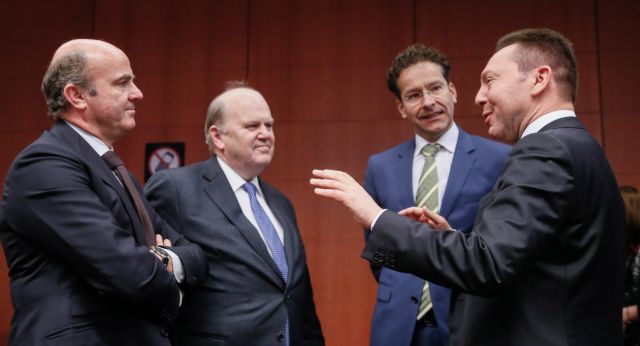
With Greece and the troika unable to come to an agreement over a number of unresolved issues, Monday’s Eurogroup in Brussels was expected to be difficult for the Minister of Finances Yannis Stournaras, as his European counterparts urged him to find a solution with Greece’s creditors.
While Greece’s progress fiscal progress is commendable, the European ministers were critical of the delays observed in reforms and structural changes to the economy. The troika also stressed that a number of prior actions still remain unresolved, therefore it cannot approve the next loan installment.
The Eurogroup president Jeroen Dijsselbloem essentially blamed Greece for the significant delays in the troika’s review and urged the Greek side to honor its commitments. Mr. Dijsselbloem note that “we are slightly optimistic” in completing negotiations by Sunday.
Regarding the capital needs of the banks, Mr. Dijsselbloem noted that the responsibility lies with the Bank of Greece and explained that the Eurogroup documented the results announced by the Bank of Greece and the recapitalization plans of the Greek banks. The Eurogroup president also referred to future stress tests performed by the European Central Bank (ECB).
Mr. Dijsselbloem revealed that the decision for the 10.1 billion euro loan installment will be taken at the informal Eurogroup scheduled for the 1st of April in Athens, without however discounting the possibility of coming to an agreement by Sunday. European Commissioner Olli Rehn was more reserved in his estimations of an agreement by the end of the week.
Based on information made available to To Vima, the ECB president Mario Draghi is keeping a distance from the Bank of Greece manager Provopoulos and the IMF and is considering performing his own stress tests to determine the needs of Greek banks.
The troika’s return
The Ministry of Finances wants to complete negotiations by Sunday, however the troika is not as optimistic, with some troika officers estimating that the EU, ECB and IMF teams will have to remain in Athens for a further ten days. In any case, Mr. Dijsselbloem has clarified that unless an agreement with the troika is reached, the loan will not be approved.
Amongst the troika demands is for the Greek government to legislate on the deregulation of mass dismissals, with the Minister of Labor counter-proposing the development of the Supreme Labor Council. Additionally, he committed to establishing a team of experts to examine the social security system’s sustainability in 2014.
According to a high-ranking Finance Ministry official, the troika also appears to have made new demands from the Greek government, amongst which is for a unanimous vote being necessary for a strike to come into effect, freezing wages and reintroducing the lock out. The Ministry official noted that these are not prior actions.
The ECB and IMF’s stance on the bank recapitalization needs will be particularly interesting, nevertheless the Greek side is optimistic since the troika has lessened its demands regarding the necessary funds and time needed.
Finally, the Bloomberg news agency reported that the troika is not too keen on Greece returning to the markets, as it feels that it may relapse and risk all reform efforts. The only way for the troika to ensure that the reforms continue is for a new loan to be signed and further measures to be introduced.