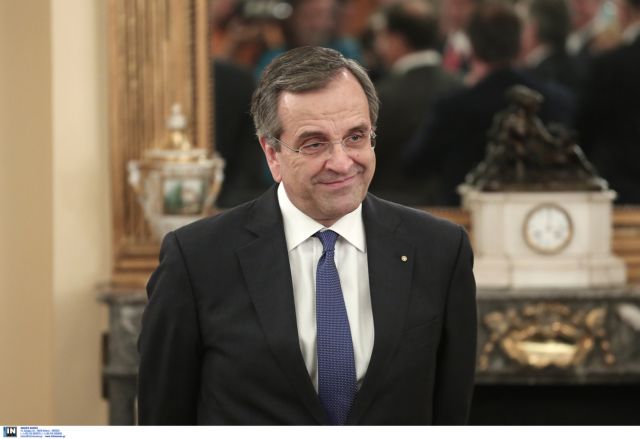
The Prime Minister Antonis Samaras gave an exclusive interview to Aris Ravanos which was published in the Sunday edition of To Vima. This is the Prime Minister’s first interview since the recent cabinet reshuffle. In the interview Mr. Samaras argues that while his overall plan is the same (“leave behind the crisis and the bailouts, focus on growth”), the Prime Minister claims that the country is in a far better place than where it was two or even one year ago.
Mr. Samaras explained that, thanks to the strict implementation of the bailout program and the primary surpluses, Greece can quickly become a “normal country” and slowly begin “restoring some of the injustices”, particularly in unemployment. When asked however what sort of injustices he plans on addressing in the near future, the Prime Minister was rather vague.
Regarding the IMF’s fears of “reform fatigue” hitting Greece, the PM admits that while some delays have occurred –as with every other country in a similar situation– there has never been an issue of “reform fatigue” in Greece. Mr. Samaras countered that at times reforms were presented as a “bitter pill”, rather than salvation for society. From now on “the benefits from reforms will be increasingly become more apparent”.
Elsewhere in the interview, Mr. Samaras notes that so long as the coalition government achieves the goals which have been set, it will have the leeway to take bold initiatives of his own. The Prime Minister offered examples of such initiatives being made by the newly-appointed Finance Minister Gikas Hardouvelis.
The possibility of reducing the tax burden on the Greek people, such as abolishing the emergency solidarity contributions or the emergency real estate tax hike, Mr. Samaras revealed that such decisions will be made in the autumn, when he will have a clearer impression on tax revenue, surpluses and goals. Mr. Samaras repeated his promise of “o further across-the-board austerity measures, in any form”.
The Prime Minister claimed that many privatizations are currently under way and stressed that a wave of investments is expected, following the recent visits from the leaders of Azerbaijan, China and Kuwait. Mr. Samaras alleged that investments in infrastructures, transports and energy will turn Greece into an international trade hub for Europe.
As for the critical negotiations with Greece’s creditors regarding the sustainability of the public debt, Mr. Samaras was vague in his response, but noted that it was the “third step” towards exiting the crisis, the previous two being achieving primary surpluses and returning to the credit markets. The talks are to begin in autumn, with Mr. Samaras confident that the debt will be declared sustainable.
When asked about the possibility of early elections, given that a 180-MP parliamentary majority is necessary to elect a new President in early 2015, Mr. Samaras was confident that his coalition government would secure the necessary votes. Mr. Samaras also insisted that he would complete his four-year tenure as Prime Minister.
At this point Mr. Samaras also accused his main political opponent, SYRIZA leader Alexis Tsipras, of “democratic immaturity” and argued that SYRIZA would suffer a “strategic defeat” when Greece overcomes the crisis. The Prime Minister accused Mr. Tsipras of adopting a populist profile and being “politically underdeveloped”.
Regarding New Democracy, Mr. Samaras noted that a new, “truly European” cycle has begun for his party and estimated that his party has managed to “unite the Greek people”.