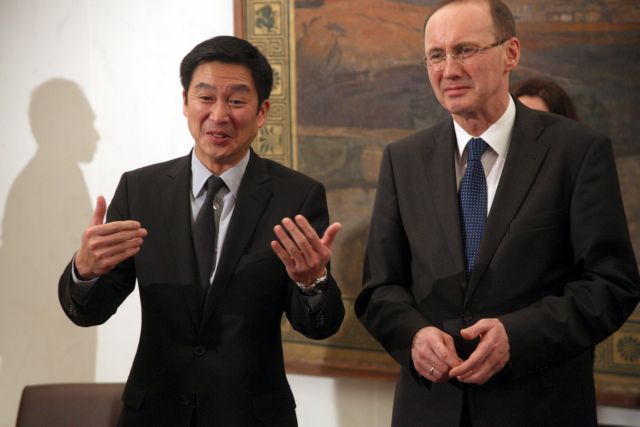
The Vice President of the European Parliament Otmar Karas and his team of auditors are scheduled to announce their findings regarding the implementation of troika policies on the EU member states that received bailouts.
Mr. Karas, who is being accompanied by French MEP Liêm Hoang-Ngoc and representatives of the Committee on Economic and Monetary Affairs, is scheduled to meet the Minister of Finances Yannis Stournaras today at 11 and will later give a press conference at the Office of European Parliament in Athens at around 12:30.
Over the next two days Mr. Karas’ team will meet with committees of the Greek Parliament, the vice presidents of the Bank of Greece, representatives of the Greek Banking Union and a number of trade unions, chambers of commerce and others.
Based on the committee’s draft reports so far, the overall consensus is that the troika’s estimations were off with regards to the Greek, Irish, Portuguese and Cypriot rescue plans. The study will also show that the troika members had difference agendas and opinions on tackling the problems; the IMF was in favor of structural changes, while the EC promoted fiscal consolidation.
Nevertheless, the study will highlight the fact the Finance Ministers of countries receiving the bailouts appear to confirm that the emergency assistance programs were necessary.
The study will stress that the troika’s policies caused a huge surge in unemployment, particularly youth unemployment, massive income loss and the retraction of state economies. Overall though, the report claims that the financial crisis’ consequences would be worse without the troika’s intervention.
The main argument is that otherwise the four counties would be facing a default, which would potentially trigger even harsher and more sudden effects and changes, with the banks collapsing and the crisis spreading to countries outside the Eurozone. Ultimately Mr. Karas admits that the troika was necessary, but greater transparency, control and dialog is necessary.