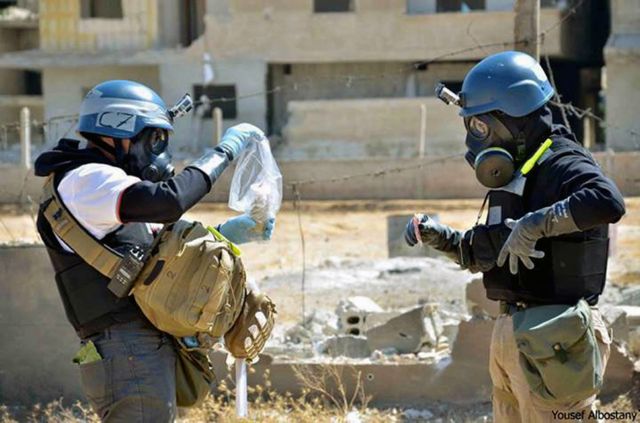
The Embassy of the United States of America appears to have sent two non-papers, in September and the holiday season, requesting Greece to assist in the operation for the safe destruction of the chemical weapons recovered in Syria.
According to rumors, Greece has been careful in its response to the request and has been reluctant to offer a port or land-based facilities. Furthermore, Athens has requested that the chemicals not be transferred north of Crete, in order to avoid security and environmental threats that will have an impact on tourism.
Greece has not, however, ruled out assisting financially in the planned destruction of Syria’s chemical arsenal. Although the deal between the USA and Russia in August to destroy the chemical arms was praised internationally, the planning has shown that there are many problems that have yet to be addressed; the chemicals were meant to be transferred outside of Syria by the end of December 2013 and destroyed by June 2014.
With the December deadline already missed and time running out, discussions suggest the possibility of chemical waste being dumped in the Mediterranean, in an area between Crete, Malta and Libya. This scenario is increasingly becoming likelier since Italy has promised to offer a port for the two Danish and Norwegian ships which will transport the lethal chemical weapons.
Initially the plan was to destroy the weapons in Albania, however negotiations with the Albanian government fell through. The Organization for the Prohibition of Chemical Weapons (OPCW) has estimated that about 1,300 tons of chemical weapons, most of which are mustard gas based, will be destroyed via hydrolysis.
As there is a huge concern over the environmental impact of the dumping the waste in the Mediterranean Sea, the chemical weapons may be processed at special facilities in Germany.