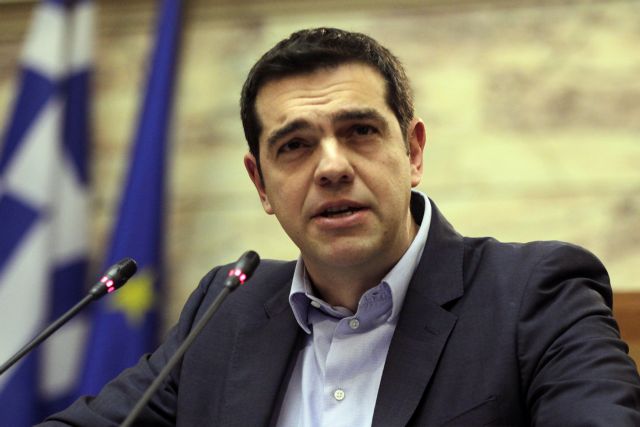
The president of SYRIZA Alexis Tsipras has his eyes set on Europe lately. He recognizes the great importance of the upcoming European elections and feels a great honor that fellow leftist parties have appointed him as candidate for the European Council presidency, and is encouraged by the messages of unity from Italy, Spain, Portugal and elsewhere.
SYRIZA executives recently went to Rome, where they met with representatives of leftist parties and social organizations, in an effort to coordinate those wishing to support Mr. Tsipras’ ballot. His associates were impressed by how the European leftist parties and social networks have welcomed Mr. Tsipras’ candidacy.
A change of correlations
Mr. Tsipras’ associates speak about a “myth” surrounding the candidacy and how it can become the foundation for an alliance of support for Greece. He listens carefully to all of this, but it is clear that is seeking legitimization and to be recognized outside of Greece. Overall, the SYRIZA president is looking forward to a change of correlations in Europe and invests in the potential of politics, against the European “economism” that has dominated in recent years.
He believes that the European political elites are trapped by their flawed models of financial politics, which are miles away from the worries of the European people; Merkel, Olli Rehn and the other bureaucrats in Brussels are unable to excite anymore.
In private, Mr. Tsipras expresses his hope that changes will gradually take place, bringing societies and the people back to forefront. He also considers the neoliberal model to be defunct and hard to defend, since it only serves privileged castes and elites. In that respect, it is only a matter of time before this doubt spreads throughout the European continent.
That is his firm belief, which will inform his European and Greek demands. At the basis of this attitude is the belief that he can defend the greater good of the European people and ideals, as they were established in the post-war era by solidarity and social cohesion.
Mr. Tsipras agrees that Europe is the most important post-war political construct in the world and often cites the example of Strasbourg, the German and French city that went from being at the center of conflict for 100 years, to becoming the symbol of peace in Europe.
In other words, he demonstrates a belief in the European perspective and the Eurozone, while his associates claim that under current circumstance, he is not even considering exiting the Eurozone. He is well aware of the huge cost such options and has outright rejected them.
Those close to him also realize that he does not intend to deny the country’s obligations. Nor does he reject the need for his government to work with balanced budgets, but rather explains that he will use additional tools of financial politics to achieve the sought after fiscal consolidation and stability.
Mr. Tsipras explains that “we know the limitations, just like the potential of politics” and adds that “our struggle for a different policy is not arbitrary and can find supporters; let us not forget that everything is fluid and in development”. If SYRIZA were to win in the European elections, it could put the pressure on countries and government that have appeared to be inflexible and resistant so far.
The potential for negotiations
The opposition leader already feels that he has the potential to negotiate, ahead of the European elections. The attempt of the European social democratic group and European Left’s efforts to approach him are indicative of the upcoming changes and Greece’s opportunities from such a political change.
To that end, Mr. Tsipras quipped that “our proposals for the Greek debt are slowly being adopted by most, to the point where I’m thinking that I having nothing more radical to discuss…”. But beyond all this, he recognizes Greece’s geopolitical status. He is well aware of Greece’s critical role to Germans and Americans alike. In private he points out that Greece and Iran have been regarded as the most important countries in the greater Southeast Mediterranean and the Middle East.
In essence, Mr. Tsipras uses politics are a counterargument to the demands of those who believe that the Europeans will eschew or isolate a SYRIZA government. As for the domestic front, he believes that is party is at the top and that “it will soon be time for the Left to rule”. He does not underestimate the domestic political and financial powers, despite arguing that they are in a fragile state after all the scandals and social disaster they have suffered from their politics.
Mr. Tsipras doesn’t consider Mr. Samaras to be a deserter. On the contrary, he feels that he will fight to the bitter end to remain in power. He doe not rule out any political or electoral surprises, nor does he underestimate the help from businesses, financial interests and foreigners. Merkel will support him until the European elections, but the government is so worn out that it will not be able to stand against SYRIZA. In any case, Mr. Tsipras is preparing for all possibilities.
“It is time to change”
The opposition leader travels abroad, debates with many domestically and is open for discussions. What he is fighting for is to abolish the fear of a radical, yet realistic Left that will at first end the social disaster, which quite a few are cultivating. Mr. Tsipras wonders “if we cannot offer our children the basics, if we deny healthcare, heating, food and education, then what is the point of politics?”
Mr. Tsipras believes that now is the time to change things in Europe and that he and his party will play a lead role in this era of “great changes”. All that remains if for his estimations to be confirmed.
Antonis Karakousis
– Originally published in the Sunday print edition