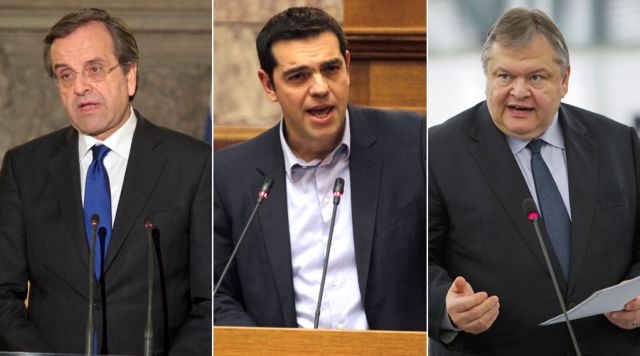
With four weeks left for the European elections and the intentions of the electorate remain, to a great extent, non-predictable.
At present nobody can safely predict the results of the 25th of May, nor the subsequent political developments.
The people aren’t really discussing he elections, they have other things on their mind; after all, there aren’t many things going on capable to shake their reality, cause any great enthusiasm or anger.
They may intend to punish the old parties, as an elder politician claims, but the Greek people’s adaptability during the crisis is unique, meaning that nobody can say with any certainty how they will act during the elections. Another politician from the north of Greece notes that “many voters are considering up to fiver parties” and concludes that “the electorate is dominated by confusion and utter disappointment”.
The pollsters also appear insecure and uncertain. The tools they have at their disposal do not allow any certainties and the changes in Greek society are so many, while the ideological shifts and consideration are even more extensive, so that everyone is cautious.
Therefore it is only natural in such vague and indeterminate times for the political spin doctors to literally be on fire, resulting in many scenarios and personal strategies for the next day emerging.
The “love affair” with the markets
The Prime Minister’s close associates appear optimistic. Mr. Samaras’ associates consider the latest financial developments to be particularly positive, they are enthused with the “love” the markets have for Greece and they naturally believe that the country is slowly starting to change, with consumption increasing, people moving more – airplane ticket sales increased 10% and the GDP rate may be positive in the first quarter of 2014.
The Prime Minister Antonis Samaras believes that he has achieved a balance and that growth will slowly start to come.
Additionally, he estimates that the people understand the difference, they are not angry anymore, sense the new reality and want stability.
Base on the above, Mr. Samaras’ close associates believe that the opposition, especially SYRIZA, have lost the train, since they are stuck in the past and do not represent the future.
In this sense, they calculate that the PM will ultimate manage to attract the conservative bourgeois that is after security and stability, making him the winner of the European elections/
In the worst case scenario, the result of the European elections will be politically insignificant and will not stop the government from carrying out its work.
That is more or less how they reject all of the doubtful scenarios that are being discussed.
However, in the Karamanlis and Mitsotakis factions there are some who estimate that New Democracy has lost steam, that Samaras’ “protective” politics has alienated many members and that the election battle has already been lost.
Whispers and scenarios
Allies of the two political families that used to dominate New Democracy believe that New Democracy will suffer a defeat similar to that of PASOK in 2012 and that serious political issues will arise on the eve of the European elections.
In their estimation, the people will use their vote to punish Mr. Samaras and the party will have to “rediscover” its ties with the center-right/
They even set electorate limits. If New Democracy is more than three points behind SYRIZA, the Prime Minister’s trusted friends claim that there will be a serious issue with the government and Mr. Samaras. The Mitsotakis family allies speak about opening up, are warming up to Mr. Theodorakis River party and cultivate the idea of forming new coalitions. The family patriarch is said to be obsessed over judicial officer Mr. P. Pikrammenos, who was Prime Minister for a month.
Similar scenarios are being discussed in the court of the declining Papandreou political dynasty, where some are looking forward to a bad result for the Olive Tree, in order to challenge Mr. Venizelos’ leadership and to renegotiate the coalition government with Mr. Samaras.
The mutual appearance of Mr. Papandreou and Mr. Kouvelis at the book presentation of the former PM’s associate Marilena Koppa after Easter did not go unnoticed and was commented on accordingly.
Despite the Papandreou environment claiming to be critical towards DIMAR for abandoning the Samaras government, the scenarios give and take.
In one version, if the Olive Tree fails, then Mr. Papandreou – after taking action against Mr. Venizelos – will form an alliance with Mr. Kouvelis in order to negotiate and ensure the continuation of the Samaras government. They have even considered terms and a political framework, such as claiming better terms for debt settlement, distributing more of the social dividend amongst the more vulnerable sections of society and reduce taxes in order to support a new government.
However there is no certainty that Mr. Samaras will enter discussions with Messrs Papandreou and Kouvelis in such a case.
It is likely that he will chose to call elections, after having formed the rumored “New Greece”, a greater center-right political party. This will be even likelier if the results in the European elections are decent.
SYRIZA’s mistakes
Things of course will be much clearer if SYRIZA and Mr. Tsipras win the European elections. Despite the recent mistakes, SYRIZA remains optimistic.
They believe that they will score a significant victory against Mr. Samaras, urging him to call general elections. They are so certain that they are preparing to run the country, asking experienced people in the public and private sector whether they could offer their valuable services to an inexperienced cabinet under Mr. Tsipras.
Not many share the optimism of Mr. Tsipras’ circle, especially after the crisis in Thrace, where the party’s inefficiencies and lack of understanding the country’s multiple and complicated problems prevailed.
There is no shortage of people who estimate that SYRIZA was harmed by its inconsistency regarding the selection of its candidates in Thrace. They tried to counterbalance this by putting Manolis Glezos on the European ballot and by overexposing the anti-German and anti-Merkelist slogans.
In any case, SYRIZA is primarily fighting against itself and their many foreign and domestic opponents will not allow the opportunity to go waste.
The upcoming European elections look like a mine field. Everything seems precarious and uncertain.
Even though their results will not determine the future of the country, they are critical.
The European elections will clear up a lot of things; they will show whether the government can go on, if SYRIZA’s claims are valid, if the new parties are accepted by society and if the people ultimately accept the hard European path, or if they are ready to accept other, unknown and untrodden roads.
Antonis Karakousis
Originally published in the Sunday print edition


